
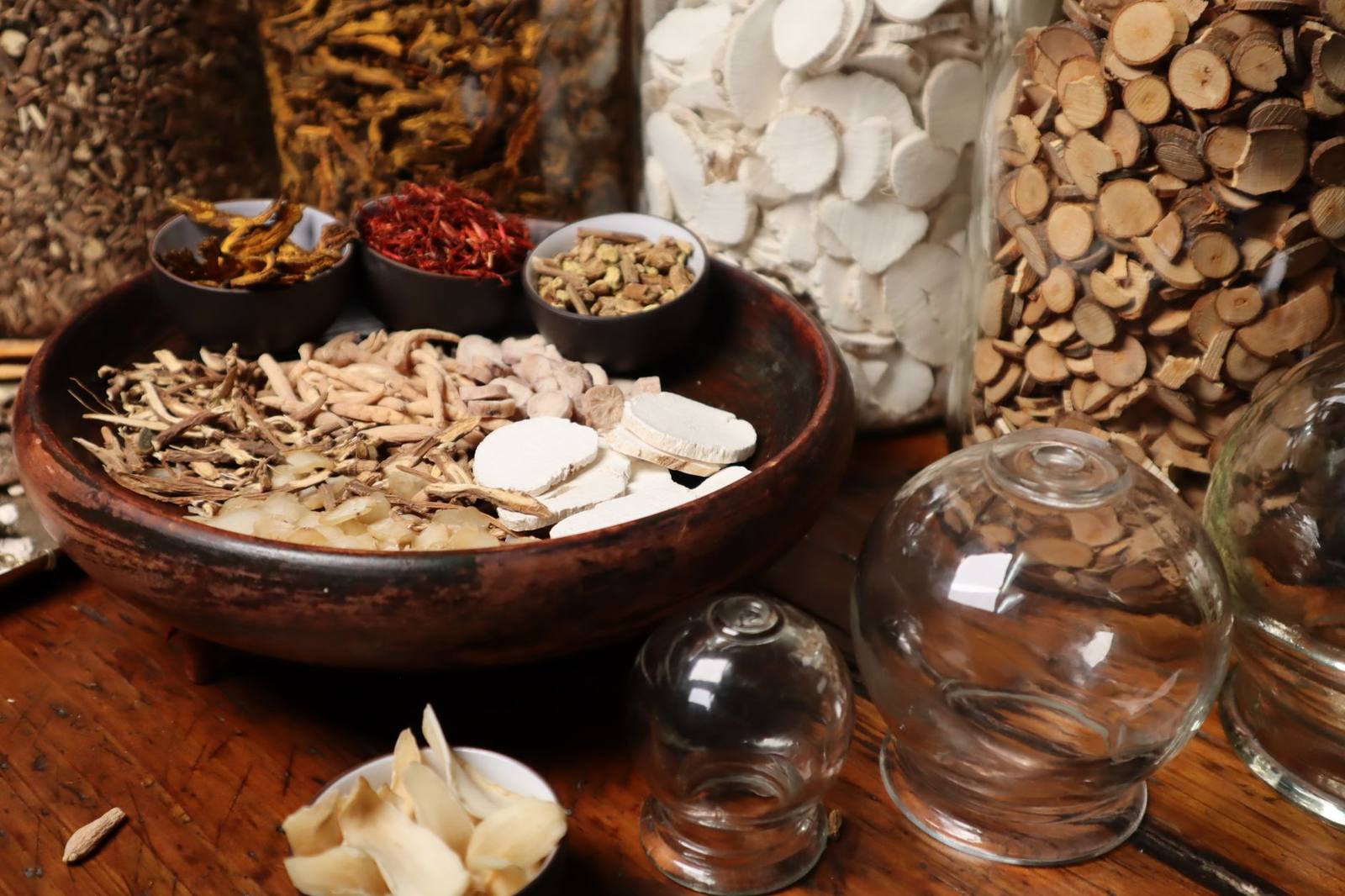
Ayurveda research is a small but growing field: the tradition is old, yet only a modest number of clinical trials have appeared in Western journals. This page summarizes what NIH reports and the safety questions worth asking.
The cooking side of the tradition, described in the guide to ayurvedic cooking, is about food and daily habits. Ayurvedic products and treatments are a different matter and carry different questions.
Where the evidence stands
The National Center for Complementary and Integrative Health (NCCIH), part of the U.S. National Institutes of Health, describes Ayurvedic treatment as combining products (mainly derived from plants, but also including animal, metal and mineral materials), diet, exercise and lifestyle. That breadth is one reason research is hard: a single “Ayurvedic treatment” may bundle many ingredients with advice about meals and movement, and a trial can rarely separate the parts.
NCCIH notes that Ayurvedic medicine and its components have been described in many scholarly articles, yet only a small number of clinical trials using these approaches have been published in Western medical journals. It also states that few well-designed clinical trials and systematic research reviews suggest that Ayurvedic approaches are effective. The organization estimates that about 240,000 American adults use Ayurvedic medicine, so the questions are not purely academic.
Reading that summary carefully matters, because “limited evidence” and “disproven” are different things. The summary does not say Ayurvedic approaches have been shown to fail. It says the quality and quantity of evidence is limited, which leaves most claims, including those made on product labels and websites, unconfirmed either way.
A practical consequence follows for readers. A claim that sounds scientific on a product page, such as a named herb “supporting” a body system, is usually extrapolated from tradition or from lab work, not from the kind of trial that would show a benefit in people. When a page cites a study, it is worth checking how many people were enrolled, how long it ran, and whether the comparison group received a different treatment or nothing.
Trials NCCIH reports
NCCIH points to a few studies that give a sense of what has been tested. They are small or short, and the agency describes most of the trials of Ayurvedic preparations for osteoarthritis and type 2 diabetes as small or not well designed.
| Condition studied | Study described | What was reported |
|---|---|---|
| Knee osteoarthritis | 2013 trial in 440 people comparing two Ayurvedic plant-extract formulations with glucosamine sulfate and celecoxib | All four products gave similar reductions in pain and improvements in function |
| Rheumatoid arthritis | Preliminary NCCIH-funded 2011 pilot study in 43 people | Conventional and Ayurvedic treatments were similarly effective |
| Type 2 diabetes | Small short-term trial of an Ayurvedic herbal formulation | Suggested it may help; other researchers said inadequate designs prevent firm conclusions |
Source: NCCIH, Ayurvedic Medicine: In Depth.
The diabetes entry shows how differently the same study can be read. The trial suggested benefit, but other researchers said the way studies were designed has not allowed firm conclusions about Ayurveda for diabetes. Both statements can be true: a small trial can be encouraging and still be too weak to settle anything.
Similar results between two products can mean that both work, or that neither does better than a placebo response would, and the knee trial design cannot tell those apart on its own. That is the standard caution about small and equivalence-style studies, and it is why NCCIH calls for better-designed trials before firm conclusions.
Metals and product quality
The clearest safety finding concerns manufactured products. NCCIH says some Ayurvedic preparations may contain lead, mercury or arsenic in amounts that can be toxic, and that the U.S. Food and Drug Administration warns that the presence of metals in some Ayurvedic products makes them potentially harmful.
It cites a 2015 survey of people who use Ayurvedic preparations in which 40 percent had elevated blood levels of lead and some had elevated blood levels of mercury. About one in four of the supplements tested had high levels of lead, and almost half had high levels of mercury. A 2015 case report in the CDC’s Morbidity and Mortality Weekly Report linked elevated blood lead in a woman to Ayurvedic preparations purchased on the Internet, and NCCIH adds that, although rare, Ayurvedic products may cause arsenic poisoning.
For a shopper, the practical lesson is that “natural” and “traditional” are not safety guarantees. The materials in some preparations are deliberately metallic or mineral, and the ingredient list on a label may not show how much of a metal is present. Independent testing information, when a seller offers it, is more informative than a heritage claim.
These findings apply to certain compounded or imported products, not to culinary spices or home cooking with ordinary ingredients. They still explain why it is sensible to treat a capsule or powder sold under an Ayurvedic label differently from a jar of cumin.
Practitioners and regulation
NCCIH reports that there is no significant regulation of Ayurvedic practice or education in the United States, and that no state requires a practitioner to have a license. Its general guidance on credentials says there is no standardized national system for credentialing complementary health practitioners, and that being licensed or certified is not always a guarantee of being qualified.
Supplements are regulated differently from medicines. As NCCIH explains on its turmeric page, dietary supplements are not approved by the FDA before they are sold to the public. A label that sounds official therefore says little about testing, purity or effect.
The same point applies to titles. A certificate on a wall or a web page can be genuine and still tell a patient little about the quality of the advice, which is why asking about training, experience and how the practitioner works alongside a patient’s regular doctor is more useful than relying on a title alone.
Safety questions to ask before using a product
The guidance above points to a short list of practical questions:
- Is this a food, a supplement or a compounded preparation, and who made it?
- Does the seller say what it was tested for, including metals?
- Does it contain several herbs or non-plant ingredients that could interact with medicine?
- Has a health care provider seen the full ingredient list?
- Is the practitioner’s training and any credential something that can be checked?
NCCIH says people should not use Ayurvedic medicine to postpone seeing a conventional health care provider about a medical problem. People who have a health condition should talk with their provider before using Ayurvedic products, and pregnant or nursing people should consult theirs because some products may contain ingredients that could be harmful. NCCIH also advises telling all health care providers about every complementary approach in use.
Simple kitchen preparations are a separate category from those products. A seed brew such as the ccf tea is made from familiar cooking spices, though even then anyone who is pregnant, ill or on medication should ask a clinician. Likewise, the daily framework in the guide to dinacharya is a traditional lifestyle pattern and not a tested therapy.
Frequently asked questions
Is there good clinical evidence for Ayurveda?
The evidence is limited. Some small studies have reported positive or similar outcomes, yet well-designed trials are scarce and firm conclusions are not available.
Can Ayurvedic products contain toxic metals?
Yes, some can. Certain preparations contain lead, mercury or arsenic at toxic levels, which is why product source and testing matter.
Are Ayurvedic practitioners licensed in the United States?
No state requires a license for Ayurvedic practice, and the field has little regulation of practice or education, so checking a practitioner’s background is up to the individual.
Should Ayurvedic treatment replace seeing a doctor?
No. It should not be used to delay seeing a conventional provider about a medical problem.