
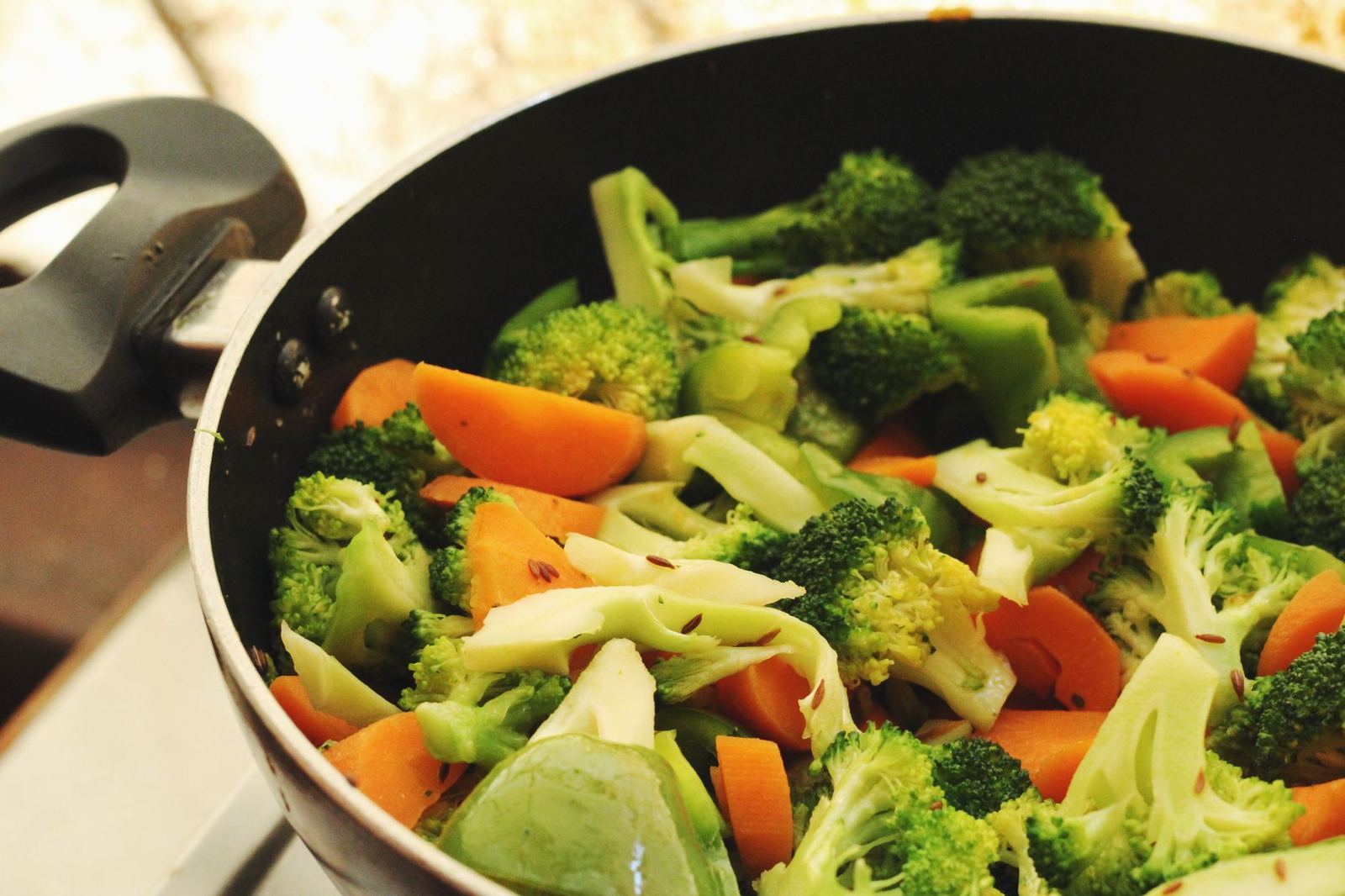
A vegetable stir fry is made by cooking small, evenly cut pieces of vegetables in a little very hot oil while stirring constantly. The three things that matter are heat, the order in which ingredients go in, and a sauce added at the end.
It is among the fastest methods in vegetarian cooking, and once the order of work is understood it adapts to almost any vegetable in the refrigerator.
What stir-frying is
Stir-frying is a cooking technique in which ingredients are fried in a small amount of very hot oil while being stirred or tossed in a wok. The technique originated in China and has spread over recent centuries into other parts of Asia and the West. It is similar to sautéing in Western cooking.
A University of Kentucky Cooperative Extension handout describes it as the brisk cooking of small cuts of ingredients in oil over intense heat. According to the same handout, the key is to keep the food moving constantly, so that all parts of the food come in contact with the hottest part of the pan, cooking quickly and evenly. The name refers to that action rather than to any particular amount of oil.
Stir-frying has also been recommended as a healthy and appealing way to prepare vegetables, meats and fish, as long as calories are kept at a reasonable level. The Harvard Nutrition Source lists salads, soups and stir-fries among its ideas for adding more tasty vegetables to meals, which makes the method a practical route to eating a wider range of produce.
Equipment: wok or skillet
The wok is the traditional utensil, and its shape is its most distinguishing feature. Woks sold in Western countries often have flat bottoms, which makes them closer to a deep frying pan and lets them sit properly on an electric stove. Carbon steel and cast iron are the most common materials.
A wok is not required. The University of Kentucky handout notes that any recipe that can be cooked in a wok can also be prepared in a large heavy skillet with deep sides, or in an electric skillet. The principle is unchanged: keep the food moving so all ingredients cook quickly and evenly. A long-handled spatula helps with tossing, because it is shaped to scoop and lift food from the sides and bottom of the pan.
Heat and the right oil
Heat is the defining variable. The extension handout says to heat the oil to a high temperature before adding the food, but the oil should not be smoking. That high heat is what lets the vegetables remain tender and crisp and keep their colour. In the traditional Chinese method described by Wikipedia, the pan is heated until very hot and the oil is added just as or before it smokes, a practice summed up by the saying “hot wok, cold oil”.
The choice of oil matters for the same reason. The handout explains that the smoke point of an oil is the temperature at which a fat breaks down, giving off smoke and producing a greasy taste and aroma. It advises a less saturated oil such as canola or corn oil, and says olive oil, butter and margarine are not suitable for stir-fry cookery because of their low smoke point.
A small amount of oil is another advantage. Stir-frying with little oil adds less fat and fewer calories than deep-fat frying.
Prep first, then cook
Because the cooking is so fast, everything has to be ready before the pan goes on the heat. The handout is blunt about it: have all ingredients prepared and within reach before heating the oil, as there will be no time to cut and chop after stir-frying begins.
Cutting is the main job. Vegetables and other ingredients should be as uniform as possible in shape and size for even cooking. Large-leaf vegetables such as cabbage or spinach do not need to be cut into small pieces on their own, but in a dish that combines ingredients, everything should be cut to roughly the same size and shape.
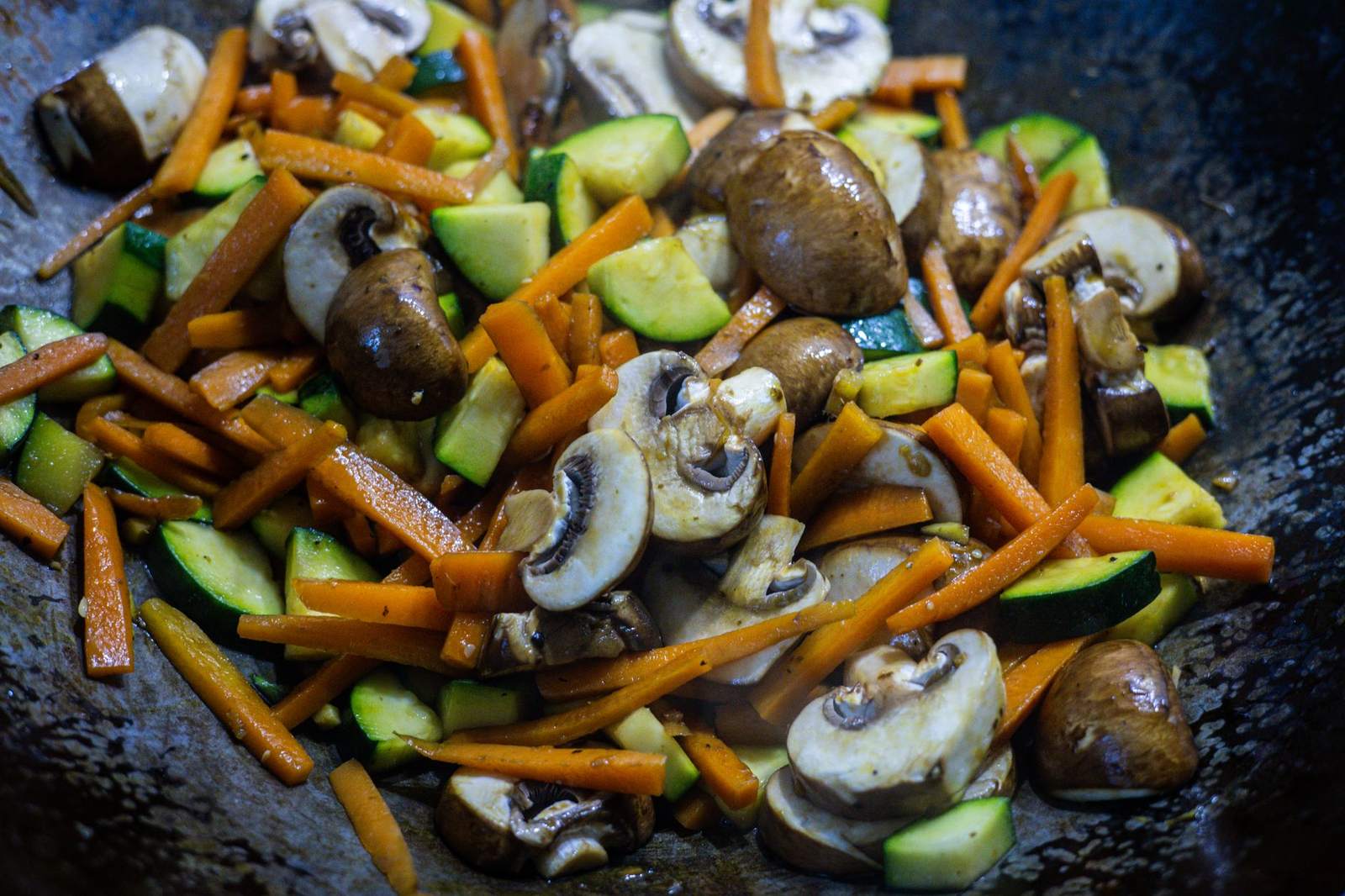
Dryness is the other half of the preparation. Wet vegetables steam instead of searing, so wash them ahead of time and let them drain or pat them dry. Leftovers from a tray of roasted root vegetables can be cut small and tossed into the pan to heat through quickly.
The order of cooking
Timing comes from sequence, not from a stopwatch. The extension handout says that vegetables which take a while to cook, such as carrots or celery, should be added before quick-cooking vegetables such as bean sprouts or tomatoes, so that all the vegetables finish at the same time. Wikipedia’s description of the Chinese method follows the same logic: the seasonings go in first, and the ingredients that take longest to cook are added first.
The seasonings are usually ginger, garlic, scallions or shallots, tossed with the spatula until fragrant. Ginger root, according to the handout, adds a distinctive spicy flavour to many Chinese dishes. A cook who prefers an Ayurvedic-style profile can use the same pan for ginger, cumin and other whole spices, adding them at this stage.
A sensible sequence for a vegetable stir fry looks like this:
- Aromatics such as ginger, garlic and scallions, only until fragrant.
- Dense vegetables, such as carrots, celery, broccoli stems or cauliflower.
- Medium vegetables, such as peppers, mushrooms or zucchini.
- Tofu, if it is part of the dish, added early enough to brown, since the longest-cooking ingredients go in first.
- Quick vegetables and leaves, such as bean sprouts, tomatoes, cabbage or spinach.
- The sauce, once the vegetables are nearly cooked.
For a cooler side dish, a cauliflower kale salad pairs well with a hot stir fry.
Sauce, thickening and seasoning
The sauce goes in last. In the Chinese method described on Wikipedia, when the meat and vegetables are nearly cooked, combinations of soy sauce, vinegar, wine, salt or sugar may be added, along with thickeners such as cornstarch, water chestnut flour or arrowroot.
The Kentucky handout gives useful rules for the thickener. A cornstarch paste should be made with cold ingredients, and when the paste is added to a hot mixture it will thicken almost immediately. Further stirring over heat will not make the mixture thicker, so it should not be over-stirred in the hope of improvement.
Soy sauce deserves a note. The handout describes it as a combination of soybeans, flour, salt and water, and says its saltiness means extra salt is not needed. Low-sodium soy sauce is available for anyone who wants less sodium, and opened bottles are best kept tightly closed and refrigerated to retain flavour.
An original basic method
This is a general, quantity-free method that follows the guidance above.
Ingredients
- An assortment of vegetables, washed, dried and cut to a similar size
- A high-smoke-point oil such as canola or corn oil
- Fresh ginger and garlic, minced
- Soy sauce or low-sodium soy sauce, with a little cornstarch mixed into cold water
- Optional: tofu, scallions, sesame seeds
Method
- Prepare every ingredient and set it within reach of the stove, including the mixed sauce.
- Heat the wok or skillet until very hot, then add the oil. It should be hot but not smoking.
- Add ginger and garlic and toss until fragrant.
- Add the longest-cooking vegetables and keep them moving. Add the rest in order of cooking time.
- When the vegetables are nearly cooked but still crisp, pour in the sauce and stir until it thickens.
- Serve straight away over rice or noodles.
Common problems
If the vegetables turn soft and watery, the pan was probably too cool, too full or the vegetables were wet. Cook in smaller batches so each addition meets a hot surface. If food burns, the heat is too high for the oil, or the pieces are uneven, so that the small ones scorch before the large ones soften.
Leftover stir-fry should be refrigerated within 2 hours, according to the USDA Food Safety and Inspection Service, and will keep for 3 to 4 days. Reheat it until it reaches 165°F. People with a health condition, who are pregnant or who take medication should talk to a clinician or dietitian before changing their diet.
Frequently asked questions
Do I need a wok to make a stir fry?
No. A large, heavy skillet with deep sides or an electric skillet works, provided the food is kept moving so it cooks quickly and evenly.
Which oil is best for stir-frying?
Extension guidance recommends a less saturated oil such as canola or corn oil. Olive oil, butter and margarine have a low smoke point and are not suitable.
How do I stop the vegetables from going soggy?
Use high heat, dry vegetables, a pan that is not overcrowded and pieces of an even size, and add the sauce only at the end.
How long can stir-fry be kept?
Refrigerate it within 2 hours of cooking and eat it within 3 to 4 days, reheating to 165°F.