
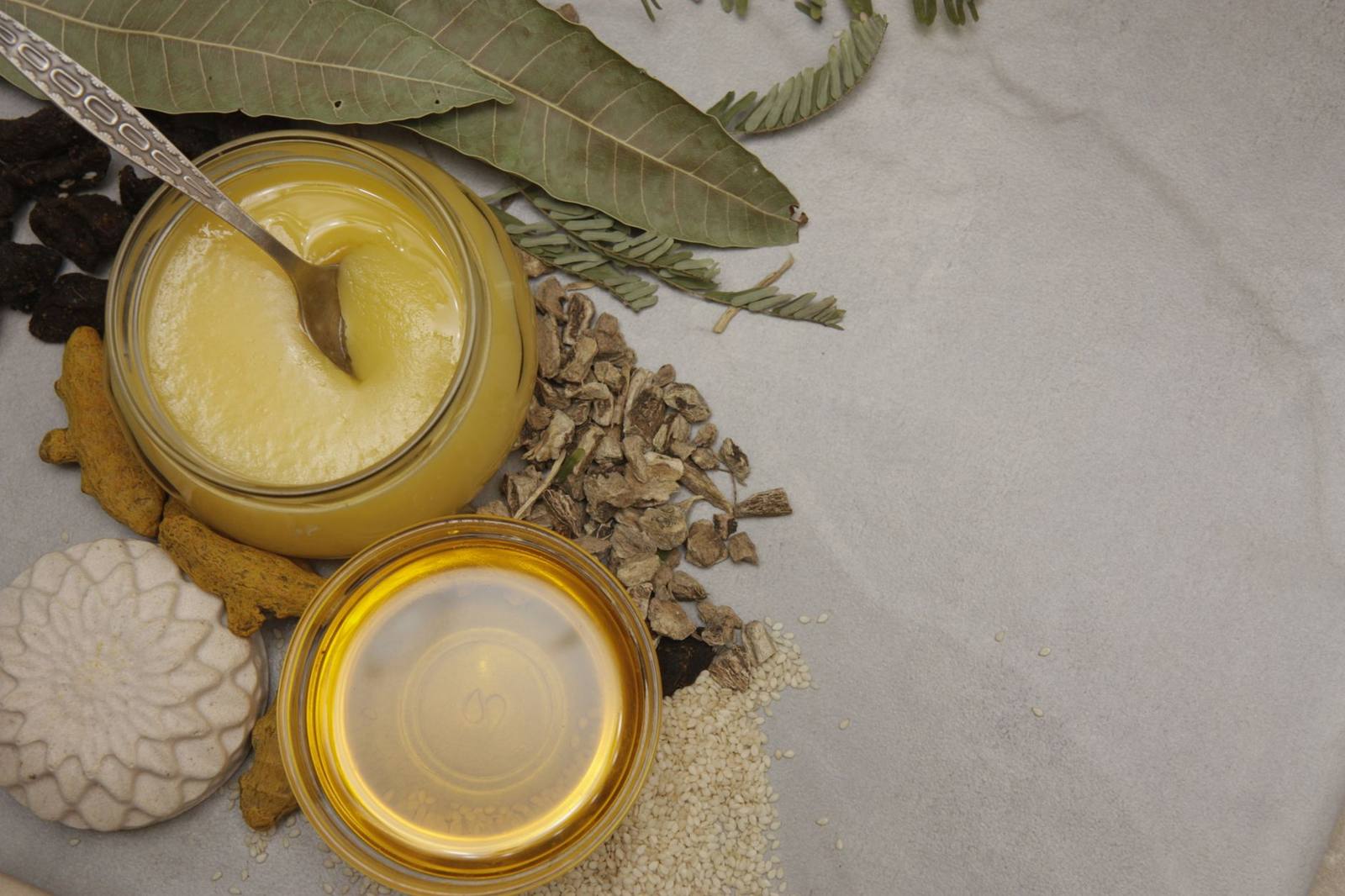
Ghee in Ayurveda is the traditional name for clarified butter, a golden fat treated as both a cooking medium and a food of special standing in Ayurvedic texts. Modern dietitians take a more measured view, and both are covered here.
Ghee is one of the most visible habits inside ayurvedic cooking, so it helps to understand what it is and what claims around it hold up.
Ghee defined: clarified butter versus butter
Butter is the fat that separates when milk or cream is churned. Ghee takes the process a step further. Cleveland Clinic dietitian Candace O’Neill explains that ghee is clarified butter, which means it’s heated to the point where manufacturers can remove any remaining water and caramelized milk solids. What remains is a fat that is even more concentrated than butter.
A review of ghee in the Journal of Ayurveda and Integrative Medicine describes the finished product as predominantly comprised of 99.5 % fat with very little moisture. That explains the behaviour in the kitchen: with the water and milk solids gone, ghee does not spatter, does not burn as easily and keeps well.
In flavour terms, the same dietitian says ghee has a nuttier, richer taste than butter, and that many people like it because it has a higher smoke point. Indian households have used it for generations. The review calls it an integral part of Indian food and culture.
The place of ghee in the Ayurvedic tradition
In the classical Ayurvedic texts, ghee is called ghrita, and it appears in sections devoted to milk and milk products. The review found that, among the animals named in the texts, cow ghee has the most mentions in the context of health benefits, followed by goat, camel and buffalo ghee.
The same review notes that ghee is recognized as a Rasayana in Ayurveda, a Sanskrit term for something said to nourish and distribute nutrients through the body. It also reports that ghee made through the curd method is highly recommended in the texts, and that old ghee is highly regarded.
The review is open about the gap between the two worlds: it calls ghee a controversial food ingredient as the modern nutritionists and codified traditional medicinal knowledge systems view it differently. Ayurveda perceives it as a healthy food, while modern nutrition focuses on its fat profile.
All of this is a description of what the tradition says, not a statement of what has been shown by clinical trials. The authors themselves treat the traditional and the modern views as two different lenses. A cook can enjoy the history without assuming the health claims have been confirmed.
Ghee and the doshas
Ayurvedic texts describe each food by how it affects the three doshas. The ghee review tabulates what the classical texts say. It reports that cow, goat and human ghee reduce all three doshas, while buffalo ghee increases pitta and horse ghee increases vata.
In practice this is why ghee is so often recommended in descriptions of eating for vata. Vata is described as dry and light, and ghee is oily and heavy, which makes it a natural counterweight. The article on the vata diet shows how that logic carries through a whole day of meals.
The tradition also says the right ghee depends on the person, since the review notes that differences between types lead to varying effects and that suitability is judged by constitution. That is traditional reasoning rather than a medical rule, and it is why the tradition does not describe a single ghee for everyone.
Ghee in the kitchen
In everyday cooking, ghee plays several roles:
- As a frying and tempering fat, where whole spices sizzle in it before they go into dals and vegetables.
- Stirred in at the end of cooking, a spoonful over rice, kichari or lentils for richness.
- Spread on flatbreads such as chapati or rotis straight from the pan.
- Used in sweets, where it carries the flavour of cardamom, saffron and jaggery.
Because ghee carries flavour so well, it is the usual fat for blooming spices. The guide to ayurvedic spices covers which seeds and rhizomes respond best to a short sizzle in hot fat.
The Cleveland Clinic dietitian recommends using ghee like butter, which is a useful rule of thumb. Wherever a recipe calls for butter for sautéing or finishing, ghee can stand in, and its higher smoke point means it tolerates the hotter pan that tempering often needs. Cooks who want a lighter result can use less of it and let the spices do more of the flavouring work.
The dietitian also offers a practical tip for jarred ghee: it can separate, so it is worth stirring before use. Storage instructions vary by brand and by whether the jar has been opened, so the label is the best guide.
The view from modern nutrition
Here the advice differs from the tradition. The UK’s National Health Service lists butter, ghee, and lard among foods high in saturated fats and says that eating too much saturated fat can raise LDL cholesterol, which can increase the risk of heart disease and stroke. It advises that men should not eat more than 30g of saturated fat a day and women no more than 20g.
Cleveland Clinic’s dietitian is direct on the comparison with butter: “there is no significant difference between the two. The fat and vitamin content is almost the same.” She adds that choosing ghee should be a matter of personal preference and not based on any perceived health benefits.
Several popular claims also come up short. On digestion, she says ghee has only a tiny amount of butyrate compared with what the colon produces, and fiber-rich foods are the better route. On weight loss, the medium-chain fats in ghee are present only in trace amounts.
For people who avoid dairy, the dietitian notes that ghee is not dairy-free, though it contains extremely low levels of lactose and casein. Anyone with a casein allergy should avoid both ghee and butter.
Sensible use of ghee
A balanced reading of the evidence is that ghee is a flavourful fat to use in measured amounts, like butter. Traditional reverence and modern caution can both be true: it can be a pleasure to cook with and still count as a saturated fat in the day’s total.
People with high cholesterol, heart disease or another health condition, anyone who is pregnant or nursing, and anyone on medication should talk with a clinician or dietitian before changing how much fat they eat. NCCIH adds that people should not use Ayurvedic medicine to postpone seeing a conventional health care provider about a medical problem.
This site is independent. It is not affiliated with any Ayurvedic school, clinic, practitioner or product brand, and it does not sell ghee or offer consultations.
Frequently asked questions
Is ghee the same as clarified butter?
Yes. Ghee is clarified butter, simmered so the water and milk solids are removed, which leaves a concentrated fat with a nutty taste.
Is ghee healthier than butter?
A Cleveland Clinic dietitian says there is no significant difference in fat and vitamin content, so the choice comes down to taste and cooking behaviour.
Can people who are lactose intolerant eat ghee?
Ghee has extremely low levels of lactose and casein, so some people tolerate it, but it is not dairy-free and a casein allergy means avoiding it.
Why is ghee so central in Ayurvedic texts?
The classical texts group it with milk products and call it a Rasayana, a nourishing food, though that is traditional description and not a clinical finding.